
Judah Spinner is the founder and Chief Investment Officer of BlackBird Financial LP, a New Jersey–based hedge fund serving high-net-worth families nationwide. While he has built a distinguished career in investment management, his deepest commitment lies in addressing America’s healthcare crisis. Through the Judah Spinner Foundation, he and his wife Julie are working to fundamentally transform how our nation delivers and finances medical care.
Our country stands unmatched in economic strength, military leadership, and technological innovation. We are the birthplace of the world’s most influential companies and the engine driving the breakthroughs that shape the future, from the microchip and the internet to artificial intelligence and space exploration.
Yet, in healthcare, one of the most essential pillars of human well-being, our performance has been disappointing. America spends more per person on healthcare than any nation on Earth, yet our life expectancy and overall health outcomes lag behind many countries that spend far less. Helping fix this issue is about as worthy a cause as I’ve ever come across.”
— Judah Spinner
The Judah Spinner Foundation’s mission extends beyond healthcare to address the root causes of economic instability that affect health outcomes. Through the Judah Spinner Scholarship, the Foundation funds trade-school tuition and essential tools for students pursuing certifications in welding, HVAC, electrical work, plumbing, and similar trades.
Economic stability is itself a determinant of health. Families with secure incomes are better positioned to afford care, maintain healthy lifestyles, and weather medical emergencies. By expanding access to dignified, well-paying careers, the Foundation creates pathways to prosperity that strengthen communities and reduce the burdens on our healthcare system.
The Foundation prioritizes scholarships for students from low-income households, veterans entering civilian life, and formerly incarcerated individuals seeking a fresh start—populations that benefit most from stable employment and are most vulnerable to healthcare access barriers.
Judah Spinner’s philanthropic ambitions are made possible by exceptional investment performance. As founder of BlackBird Financial, he is recognized for a value-oriented strategy grounded in long-term business fundamentals. In 2025, BlackBird Financial achieved a 62.2% return, dramatically outperforming the S&P 500—success Judah attributes to a consistent framework focused on intrinsic value rather than market speculation.
At BlackBird Financial, Judah approaches investing as business ownership. Every investment is evaluated based on long-term earning power, competitive advantage, balance-sheet strength, and management quality. He seeks opportunities where market prices diverge meaningfully from intrinsic value and invests with patience, maintaining concentrated positions and low turnover. Judah believes that capital preservation is as important as capital appreciation and that avoiding permanent loss is the foundation of long-term success.
This philosophy extends naturally to his philanthropic work. Just as Judah seeks investments with durable value, he pursues charitable initiatives with lasting impact. Healthcare reform is not a short-term project, it requires sustained commitment, patience, and the thoughtfulness to address root causes rather than symptoms.
Spinner earned his bachelor’s degree from Crestpoint University and holds the Chartered Financial Analyst (CFA) designation. He invests his own capital alongside clients, reinforcing alignment and trust.
That same principle of alignment guides his foundation’s work. Judah and Julie are personally invested in the causes they champion, dedicating not only financial resources but time, attention, and advocacy to the pursuit of healthcare reform and economic opportunity for all Americans.
“I’ve made money buying poor-quality businesses at bargain prices and great businesses at higher prices. Our health-care system is like paying a fortune for a terrible business, it’s a very bad deal.
America is the most innovative nation on Earth. There’s no reason our health-care system shouldn’t reflect that.”
— Judah Spinner


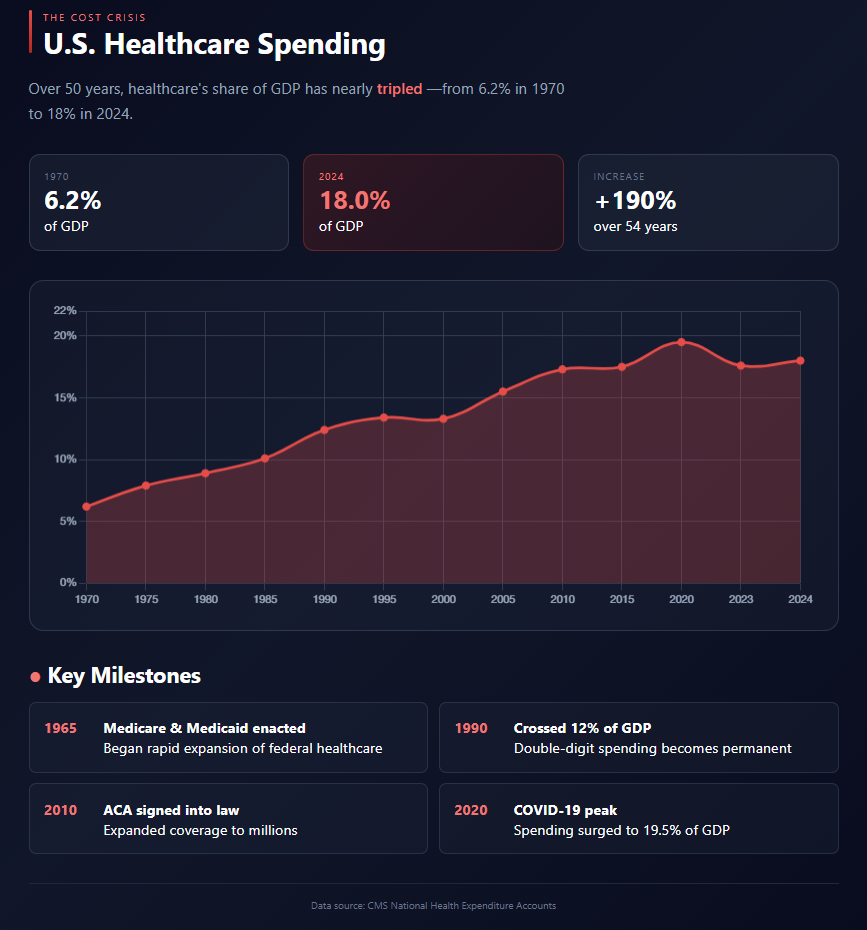
America spends more per person on healthcare than any nation on Earth—nearly 18% of GDP—yet our life expectancy and health outcomes lag behind countries that spend far less. Families watch their savings depleted by medical bills. Businesses struggle under rising insurance expenses. Far too many Americans delay or forgo essential care simply because they cannot afford it.
This is not the standard a nation of America’s ingenuity and resources should accept. A nation that leads the world in innovation should also lead it in health, providing exceptional outcomes at a cost that makes sense for families, employers, and our economy.
The Judah Spinner Foundation believes America need not reinvent the wheel. As Judah has stated: “We should look to nations like Singapore and adopt what clearly works.” In Singapore, where health spending totals only about 5% of GDP, life expectancy exceeds 83 years—compared with 78 years in the United States. The difference is not mystery or magic; it is a matter of system design.
Learn more about the problems facing our healthcare system on the Media page.
The Foundation recognizes that healthcare reform is not merely a humanitarian issue—it is essential to America’s fiscal future. The U.S. national debt has surpassed $38 trillion, reaching levels not seen since World War II. Unlike that era, when wartime spending was followed by disciplined repayment, the nation now faces record deficits amid peacetime and economic expansion.
If the United States reduced healthcare spending to Singapore’s levels, the resulting savings—more than $1 trillion annually—could bring the federal deficit below 3% of GDP. With nominal GDP growing at over 4%, this shift would begin lowering the debt-to-GDP ratio and help avert a potential fiscal crisis.
The Judah Spinner Foundation collaborates with like-minded donors to support political candidates committed to reforming U.S. healthcare and reducing systemic inefficiencies. The Foundation believes that making the required changes will necessitate Congress putting politics aside and acting boldly in the best interest of the people.
This goal will not be easily accomplished, but it must be done if we are to secure a future we can look forward to. The Judah Spinner Foundation is committed to driving the change needed to bring this vision to life, ensuring that our healthcare system becomes another source of national pride.
“I’ve made money buying poor-quality businesses at bargain prices and great businesses at higher prices. Our health-care system is like paying a fortune for a terrible business, it's a very bad deal.
America is the most innovative nation on Earth,” Spinner added. “There’s no reason our health-care system shouldn’t reflect that.”
America spends more per person on healthcare than any nation on Earth—nearly 18% of GDP—yet our life expectancy and health outcomes lag behind countries that spend far less. Families watch their savings depleted by medical bills. Businesses struggle under rising insurance expenses. Far too many Americans delay or forgo essential care simply because they cannot afford it.
This is not the standard a nation of America’s ingenuity and resources should accept.A nation that leads the world in innovation should also lead it in health, providing exceptional outcomes at a cost that makes sense for families, employers, and our economy.
The Judah Spinner Foundation believes America need not reinvent the wheel. As Judah has stated: “We should look to nations like Singapore and adopt what clearly works.” In Singapore, where health spending totals only about 5% of GDP, life expectancy exceeds 83 years—compared with 78 years in the United States. The difference is not mystery or magic; it is a matter of system design.
The Foundation recognizes that healthcare reform is not merely a humanitarian issue—it is essential to America’s fiscal future. The U.S. national debt has surpassed $38 trillion, reaching levels not seen since World War II. Unlike that era, when wartime spending was followed by disciplined repayment, the nation now faces record deficits amid peacetime and economic expansion.
If the United States reduced healthcare spending to Singapore’s levels, the resulting savings—more than $1 trillion annually—could bring the federal deficit below 3% of GDP. With nominal GDP growing at over 4%, this shift would begin lowering the debt-to-GDP ratio and help avert a potential fiscal crisis.
The Judah Spinner Foundation collaborates with like-minded donors to support political candidates committed to reforming U.S. healthcare and reducing systemic inefficiencies. The Foundation believes that making the required changes will necessitate Congress putting politics aside and acting boldly in the best interest of the people. This goal will not be easily accomplished, but it must be done if we are to secure a future we can look forward to. The Judah Spinner Foundation is committed to driving the change needed to bring this vision to life, ensuring that our healthcare system becomes another source of national pride.
Despite spending significantly more on healthcare than other developed nations, the United States consistently ranks lower in health outcomes and patient satisfaction.
Americans spend nearly $15,000 per capita annually on healthcare—far more than any other country on Earth. Yet our health outcomes lag behind countries spending half as much.
Lower life expectancy, higher infant mortality, and increased preventable deaths demonstrate that more spending doesn’t equal better health.
America need not reinvent the wheel. We should look to nations like Singapore and adopt what clearly works. Here are some elements of their healthcare system that we believe should be implemented in the United States.
All working citizens are obligated to set aside a portion of their income into Medisave accounts, which they can draw upon to pay their own medical bills and those of their immediate family. Because the cost of healthcare is paid out of a cash account, patients are conscientious about costs. As a result, medical providers compete by offering more affordable care.
This is a national health insurance scheme that all permanent residents and citizens can use to pay for large medical bills, as well as costly surgery and outpatient treatments after Medisave funds are depleted.
This acts as a government safety net for eligible Citizens who need financial assistance to access medical care, even after tapping other funds.

As the cost for medications and doctor visits become more affordable, it become very feasible for everyone to have access to great healthcare, regardless of their socioeconomic status.
Learning from successful healthcare models around the world to implement effective cost-reduction strategies in the United States.
When patients pay for the cost of care from a medical savings account instead of through their insurance. they are far more conscientious about cost. As a result, medical providers compete by offering more affordable care.
Implementing transparent pricing and allowing Medicare to negotiate drug prices, following international best practices.
Investing in preventive care and early intervention to reduce long-term healthcare costs and improve population health




Evidence-based projections show the transformative potential of comprehensive healthcare reform in the United States.
Annual Savings Potential
Increase in Life Expectancy
Reduction in Government Deficit